https://fb.watch/oTwOUMMJBl/?mibextid=Nif5oz
My reflection at this Celtic service starts at 39 minutes 39 seconds.
https://fb.watch/oTwOUMMJBl/?mibextid=Nif5oz
My reflection at this Celtic service starts at 39 minutes 39 seconds.
It has been along while since I have posted anything on this site. I would like to remedy that. This past October I entered my 78th year….And it has been quite a ride. This modality has been a journal of sorts for me following the passage of my dear wife, Sherita, and as such it has run quite a gambit. Running from my story to the underpinnings of the philosophical, theological, spiritual, political, and social aspects of what I have called the conundrum which is I.
In the next few posting I would like to try to picture some of the elements which have comprised the components of the spirituality in compassed by the title of this posting. The Wild Goose and the Dove of Peace .
Actually, it’s been a while since I started this post and I find that I can edit it at this point. The wild goose is a Celtic metaphor for the Holy Spirit, and really is a part of what I am becoming and understanding the breath of what Christ was actually teaching For those who would hear. The next post is ,I hope, A link to a labyrinth walk installed some years ago by myself and friends from Waters edge church. It is linked to another post. I will post shortly which is a reflection. I am planning on presenting at a local church. All of this combined presents a picture I am very comfortable to be a part of. Pox et Bonum! RV
From the Center for Action and Contemplation

Week Thirty-eight
An Unspeakable Name
Monday, September 21, 2020
Remember what God said to Moses: “I AM Who I AM” (Exodus 3:14). God is clearly not tied to a name, nor does God seem to want us to tie Divinity to any one name. Which is why, in Judaism, God’s statement to Moses became God’s unspeakable and unnamable identity. Some would say that the name of God literally cannot be “spoken,” only breathed. [1] Now that was very wise, and sometimes I wish we had kept it up. This tradition alone should tell us to practice profound humility in regard to God, who gives us not a name, but only pure presence—no handle that could allow us to think we “know” who God is or have the divine as our private possession.
The Christ is always far too much for us, larger than any one era, culture, empire, or religion. Its radical inclusivity is a threat to any power structure and any form of arrogant thinking. Jesus by himself has usually been limited by the evolution of human consciousness in these first two thousand years, and held captive by culture, nationalism, and Western Christianity’s own cultural captivity to a white, bourgeois, and Eurocentric worldview. We have often missed the ways Jesus reveals himself, because “there stood among us one we did not recognize” (John 1:26). He came in mid-tone skin, from the underclass, a male body with a female soul, from an often-hated religion, and living on the very cusp between East and West. No one owns him, and no one ever will.
Jesus clearly says naming God correctly is not the priority, “Do not believe those who say ‘Lord, Lord’” (Matthew 7:21; Luke 6:46. Italics added). It is those who “do it right” that matter, he says, not those who “say it right.” Yet verbal orthodoxy has been Christianity’s preoccupation, at times even allowing us to burn people at the stake for not “saying it right.” We ended up spreading national cultures under the rubric of Jesus, instead of a universally liberating message under the name of Christ. What I call an incarnational worldview is the profound recognition of the presence of the divine in literally “every thing” and “every one.”
I would go so far as to say that the proof that you are a mature Christian is that you can see Christ everywhere else. Authentic God experience always exp
ands your seeing and never constricts it. What else would be worthy of God? In God you do not include less and less; you always see and love more and more. And it is from this place that we lose any fear we have about entering into discussion, prayer, and friendship with people of other faith traditions.
Gateway to Action & Contemplation:
AloHa!
RV




Page Two
One day in 1976ish Bill called me and let me know that he had found and looked into his sealed birth certificate at the Alameda County courthouse. He also saw mine but he didn't unseal it at the time. I subsequently headed to the Bay Area as soon as practical. We never got into trouble for this violation but since then they have moved all archived records to Sacramento.
On that foray into my hidden history I did confirm my Bio mom's name and address at my birth in 1944. There was No information on my Bio father.
Armed with her full name, Helene Ann Vincent(e), I embarked on a search of marriage records(none located in California) and birth records which did yield her parents names and location. Of course they had long left the ranch they lived on, in Benicia, before the bridge was built. Years later, when I did find my Bio grandma(Amelia Costa) she told me about watching them build the Carquinez Bridge(1922-27). Of course, on Helene Ann Vincent(e) birth certificate the name Amelia Costa was not listed and her maiden name was DeSouza.
So for the time being I just looked in phone books of the Bay Area under the name Vincent or Vincente. One afternoon in 1984 I spoke with a cousin of Helene's. He remembered playing with her as a child and he thought she had married, moved away, and since had passed away...But he thought her mom, Amelia, was living somewhere in the East Bay. Soo...I started seeking out DeSouza's in the county. I found no listing for Amelia Souza or DeSouza or Vincente. I finally did connect with her sister in law in West Pittsburg(California), married to her brother John. She took my story and said she would call Amelia(unlisted phone) and get back to me. Within the hour she called me back and said Amelia would like to meet me. I headed over to the Antioch address she gave me with no small degree of trepidation!
Here I go to meet a lady in her 80's, claiming to be her illegitimate grandchild from forty years ago. I feared I would give her a heart attack.
My fears were relieved when she opened the door. It felt like we were connected at once, It just felt like we were family. We spoke for over two hours during which time she told me of my Bio mom(who had passed away in 1970), And my three half brothers in Seattle, And her widow, Howard, who Amelia had No love for! I left and drove North to Ashland on Cloud 9 or 10.
To Be Continued:

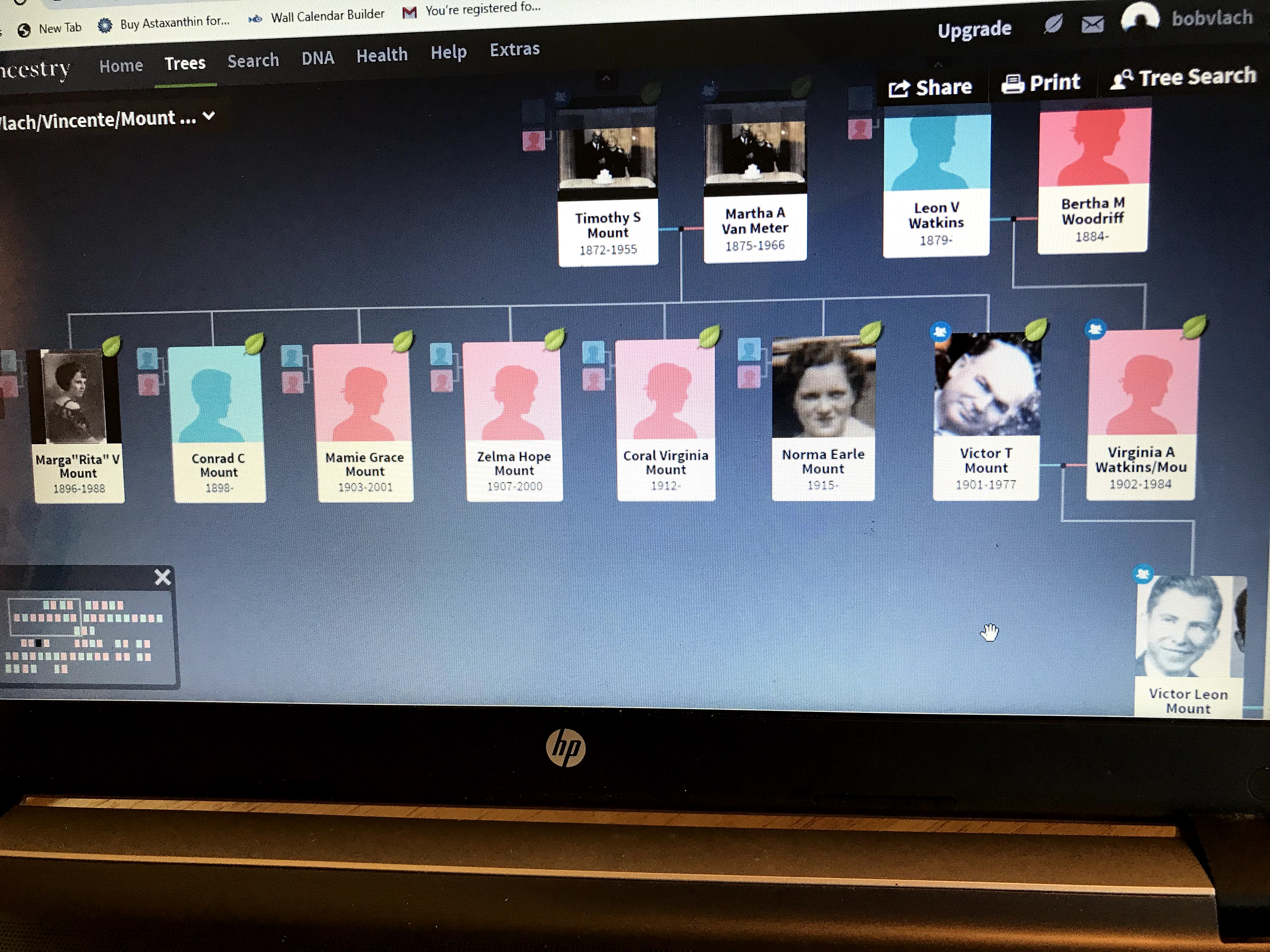
I am trying to put down my story as it seems the older I get, the more I forget ...And the more I am finding out. This genetic time line has taken many twists along the path but in spite of dead ends and lost links it has been very colorful and fruitful over the past forty plus years. Soo here goes. Most of this connection is recorded in other formats but primarily now on Ancestry.com utilizing the family tree function. A seeker of DNA components to their past could use other companies. However it is a fact that these guys have the biggest database to work with and when searching the world for answers that size does matter. It can also lead you astray as there are many rabbit holes out there. I should probably title this “The Bob’s DNA Story”...However..it is very important that anyone seeking information as I have to realize that there is so much more in your makeup than DNA. DNA is very important but culture and nuclear family are at least as important. That is why I wince when people use terms like “my Real parents”. Jack and Virginia were my real parents as were my bioparents, and Bill is my very real brother.
The conundrum to be known as Robert Michael Vlach was born on October 7th 1944 at Providence hospital in Oakland, California. At birth I was adopted by John Tormey and Virginia Mary Vlach. My first home was on a ranch near Port Chicago in Contra Costa county owned by Jack’s parents John Douglas and Loretta Vlach.
In August 1946 my parents adopted another boy from the same hospital, William Patrick.
We lived on the ranch until my dad passed away in our mid teens, from heart valve failure. A result of Rheumatic Fever in his early years. Probably one of the first of many ironic twists in my life’s journey was that a couple of years later they invented the artificial heart as well as the use of replacement heart valves from pigs.
Following the passing of my adopted father, Bill, mom and I moved to Sacramento to be closer to her brothers. We both finished high school in Sacramento and then I went on to Sacramento State College to graduation. Bill went to San Francisco following high school, going first to San Francisco State and then on to a very successful career in the mental health field. Our mom never kept our adoption status a secret but she had very little information in her records and neither Bill or I really pursued our histories in earnest until many years later,
To Be Continued:

Having just returned from Palmdale, California visiting Michael and Garret I am now on quarentine in my home in Kalaheo for two weeks because of the concerns over Covid 19 virus. This seems the ideal time to reconnect to this blog...The primary need to do this now is to codify the most recent developments in my adoptive journey. Much of which has actually come to light in the past few years. And this transitionary post has as its pictorial heading a book I am reading and which our centering prayer group are sharing weekly. "The Universal Christ" is one of the latest books by Fr Richard Rohr. I call it his Magnum Opus or his greatest work. If you have ever read a book and find it difficult to highlight significant passages then that describes this one. All of this is significant and Kind and Loving and Transformative. It truly encapsulates the essence of most of his work, and that of others as well, from the past fifty years. Not to even try to compare my feeble work on this site to his but my point is that for me I have pretty much put that which is me out here on this blog. From here out I am kind of fleshing out little things like my DNA and adoptive history. Pax et Bonum! RV


In CAC's recent issue of Oneing, Mirabai Starr reflects on the three stages of prayer taught by Teresa of Avila (1515-1582) in her book The Way of Perfection. She invites us into deepening intimacy with God:
Teresa names the first stage the Prayer of Recollection. When we make the effort to set aside time to be still and turn inward, we gather all our faculties to a single point of concentration and invite the presence of the sacred to enter us. . . . In this state, we may find that what the Buddhists call "monkey mind" continues to chatter for a while, but gradually things settle down and a kind of spaciousness begins to open between the thoughts, and that's where the Holy One slips in to sit beside us.
The Prayer of Recollection involves our active participation. It requires discipline, concentration, and a willingness to endure both mental turmoil and spiritual aridity. It is an act of purification; by scouring the vessel of our souls with the practice of prayer, we empty ourselves so that the Beloved may fill us.
At that point, we may enter the Prayer of Quiet. Now that the labor of recollection has cleansed us, we are ready to receive the infusion of divine light. This is a state of grace. . . . Once we have gathered our senses and intellect, a feeling of deep peace and quietude may wash over us like a warm wave. This is an exceedingly delicate experience. . . . We cannot manufacture or manipulate this stage of prayer. We can only make ourselves ready to receive it when it comes and, in the words of the late meditation teacher Stephen Levine, we "hold on tightly and let go lightly." [1]
In Teresa's final stage, the Prayer of Union, any sense of an individualized self slips away. The soul merges with the Divine, like a drop of water into the boundless sea. The Beloved, who, as it turns out, has longed for the lover as fervently as she has desired him, makes her one with him. The Prayer of Union is usually fleeting, but its impact endures. Each time God blesses us with these unitive experiences, we are forever transformed. We are likely to still bumble through the human condition, behaving unskillfully at times and with more grace at others, but with each taste of union we identify a little less with the individual personality and more with our essential unity with the Divine. We are less likely to take passing circumstances as seriously as we used to. Our values shift from acquiring security to serving the One through being of service in the world.
The contemplative life is not a matter of achieving some artificial state of perfection available only to the spiritual elite, who glide past the obstacles that throw off the rest of us. It is a matter of being so fully present to the moment that we cannot help but catch a glimpse of God in all that is. "Which of my blessings," the Holy One asks in the Qur'an, "will you deny?" [2]
Teresa of Avila is one of the great advocates and models of the power of simply sitting for a few minutes each day in silence and stillness, and striking up a conversation with the One who is waiting to love us unconditionally, the One who will never leave us, the One who is not different from the essence of who we truly are. [3]
|
 |


Richard Rohr's Daily Meditation
|
 |
|
Transformation:
Week 1
|
|
The Ark of the Covenant
Monday, June 27, 2016
|
In his book The Soul's Journey into God, Franciscan theologian Bonaventure uses a most wonderful Old Testament metaphor to describe the contemplative mind; he says it is like the Ark of the Covenant housed within Israel's temple. [1] Exodus 25 describes in great detail how the Ark was to be built. It was first of all a kind of traveling temple so the Israelites could carry God around with them, wherever they went, until they finally settled the Ark in Solomon's permanent temple. But it didn't really hold God, which would have been idolatrous. The Ark of the Covenant was instead the "place-holder" for God--a brilliant metaphor!
The open space above the Ark of the Covenant was rightly called the "Throne of Mercy." Two golden cherubs protected the empty space, directly facing each other. "In that space," God says, "I will meet you" (Exodus 25:22). Mercy multiplies inside such open and free space. This is the work of contemplation--"guarding your mind and your heart" (Philippians 4:7) so that a Larger Presence can show itself. Such silence and emptiness is open to infinite horizons and True Transcendence in the way that nothing else quite is. Words always whittle God into small parts that we can seemingly grasp and understand. Read Max Picard's classic book, The World of Silence, where he masterfully describes this phenomenon. [2]
The golden cherubs protect an infinite opening, a silent unknowing that is a different kind of knowing altogether, a fully open space that only God can fill and inhabit, never our own small ideas and passing feelings. It is in this eternal, endless space where Yahweh rightly says to Israel, "I will meet you." Every other playing field is far too small.
Protecting infinite, empty, and merciful space is precisely what you do in contemplative practice. Most of what we call thinking is narcissistic reaction to the moment. Moment by moment, you're judging things and labeling them, whether they attract or repel you. That really isn't thinking, but self-centered reactions and the stating of your preferences to yourself. It takes work to return to the Ark of the Covenant, the placeholder space within you that is quiet, that doesn't get caught up in all your commentaries and emotional evaluations, up and down, in and out, with or against. Some kind of contemplative practice will allow you to watch yourself doing all of this and notice how futile it all is. In contemplation, your inner witness is still, like the golden cherubs, and lets everything else float by. It observes and learns from your thoughts and sensations, but it doesn't attach to any of them. It lets go and lets go and lets go.
This takes years of practice, until letting go becomes an art form. You learn not to be so opinionated, not to be emotionally dragged up and down, but to stay in this quiet place that watches everything come and go with calm equanimity. When you learn how to stay here, you'll recognize you are not your thinking and you are not your feelings. What you were thinking even an hour ago, you're not thinking anymore. Therefore it is not you. Your thinking is essentially unstable. Yet most people think they are their thinking! Such a life is inherently insecure. Many people in contemporary secular society have little solid ground on which to stand, to create a mature and happy life.
|
 |
 |
Gateway to Silence
Teach me how to see.
|